
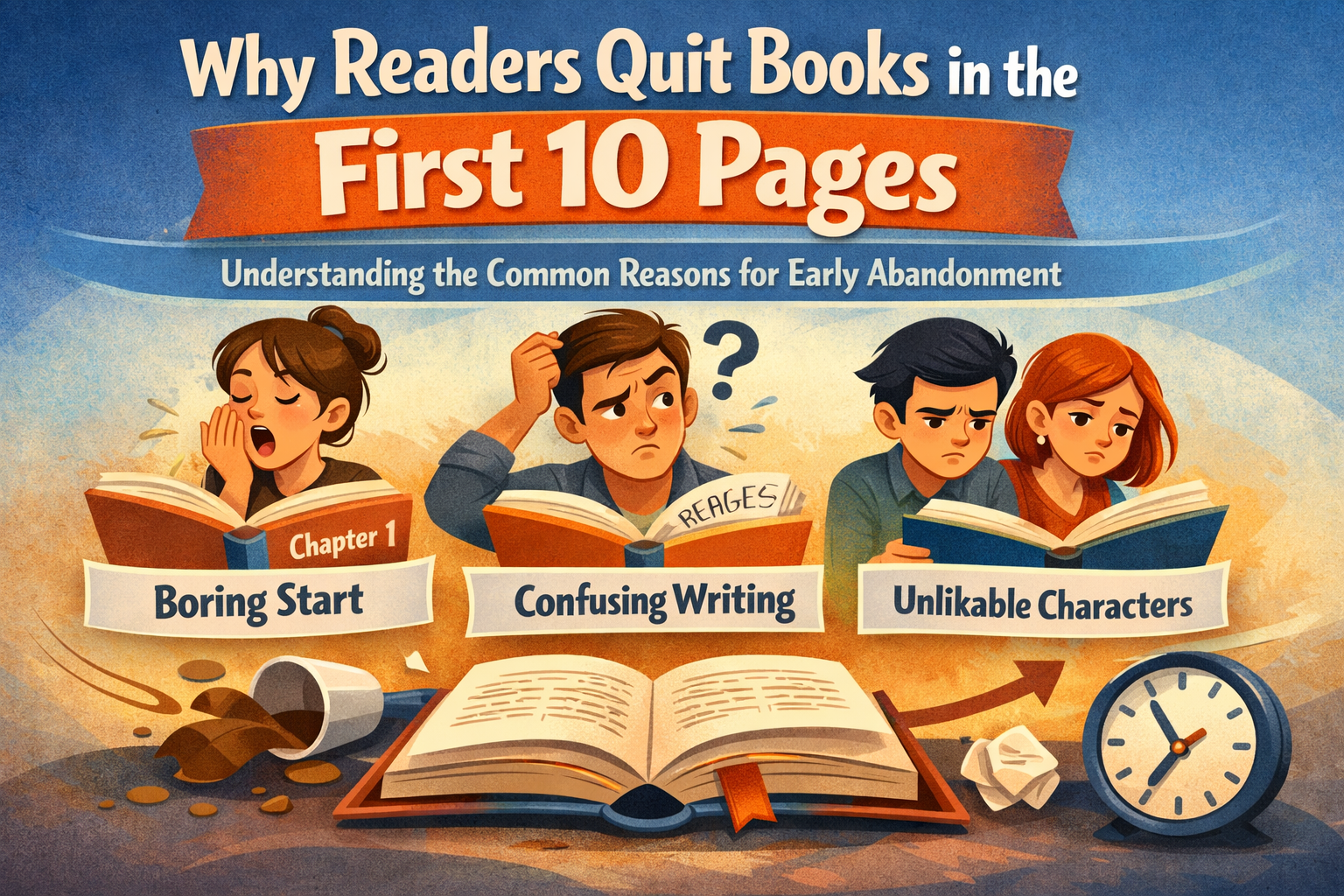
Every author has felt it—that sinking feeling when a book doesn’t get the traction it deserves. You might have spent months (or years) crafting your story, polishing your prose, and designing a beautiful cover, yet readers still drop off almost immediately. The hard truth is this: most readers decide whether to continue a book within the first 10 pages.
This isn’t about harsh judgment or short attention spans alone. It’s about reader psychology, expectations, and how quickly a book earns trust. Understanding why readers quit books early can help you fix the issues before they cost you reviews, sales, and long-term credibility.
Let’s break down the real reasons readers stop reading—and how you can prevent it.
The First 10 Pages Are a Trust Test
When a reader opens a book, they’re making an emotional and intellectual investment. Consciously or not, they’re asking:
- Is this book worth my time?
- Does the author know what they’re doing?
- Am I in safe hands as a reader?
If the answer isn’t clear early on, readers don’t wait around. With endless alternatives available, especially in digital bookstores, moving on is effortless.
1. A Weak or Confusing Opening
One of the most common reasons readers quit is a lack of clarity in the opening pages.
This doesn’t mean every book needs action in the first paragraph. It means the reader needs a clear sense of:
- What kind of story they’re reading
- Whose story it is
- Why they should care
Problems arise when openings are overloaded with vague descriptions, abstract thoughts, or long backstory dumps. Readers feel lost before they’re invested.
A strong opening grounds the reader quickly and gives them a reason to keep going—even if all the answers aren’t revealed yet.
2. Slow Pacing With No Emotional Hook
Many authors confuse “slow burn” with “slow start.” Readers are patient, but they’re not passive.
If nothing changes in the first 10 pages—no tension, no question, no emotional pull—readers disengage. Even quiet stories need momentum. Momentum doesn’t require explosions; it requires movement.
This could be:
- An internal conflict
- A compelling question
- A subtle disruption to the character’s normal world
Without that, readers feel like the book is warming up instead of starting.
3. Poor Formatting and Presentation
This is one of the most underestimated reasons readers quit early.
Even great writing suffers when it’s presented poorly. Common issues include:
- Dense paragraphs with no breathing room
- Inconsistent fonts or spacing
- Awkward line breaks
- Missing or broken chapter structure
- Unprofessional layout on eReaders
Readers may not articulate this in reviews, but they feel it instantly. Poor formatting signals a lack of care and makes reading feel like work rather than enjoyment.
Professional formatting doesn’t just make a book look good—it makes it readable, which directly impacts whether readers continue.
4. Flat or Unlikable Characters
Readers don’t need to love a character immediately, but they do need to feel something.
When characters feel generic, overly perfect, or emotionally distant, readers struggle to connect. This is especially true in the opening pages, where emotional engagement is critical.
Early character moments should reveal:
- Desire (what the character wants)
- Conflict (what’s in the way)
- Vulnerability (why we should care)
Without these elements, readers don’t see a reason to stay invested.
5. Overwhelming World-Building or Information Dumps
World-building is important, but dumping too much information too soon is one of the fastest ways to lose readers.
Long explanations about history, systems, or backstory can feel exhausting when readers haven’t yet decided they care about the world or the characters in it.
Effective storytelling reveals information gradually, through action, dialogue, and context. Readers want to discover the world—not be lectured about it.
6. Mismatch Between Promise and Delivery
Sometimes readers quit not because the writing is bad, but because the book isn’t what they expected.
This happens when:
- The tone doesn’t match the genre
- The blurb overpromises something the opening doesn’t deliver
- The cover suggests one type of story, but the content feels different
When expectations aren’t met quickly, readers feel misled—even unintentionally—and move on.
Alignment between cover, description, and opening pages is essential for reader retention.
7. Weak Dialogue or Unnatural Writing
Dialogue that feels stiff, overly explanatory, or unrealistic pulls readers out of the story instantly. The same goes for prose that tries too hard to sound “writerly” at the expense of clarity.
In the first 10 pages, readers are extremely sensitive to:
- Forced exposition in dialogue
- Overly complex sentence structures
- Excessive telling instead of showing
Clean, natural writing builds trust. Readers want to feel immersed, not impressed.
8. Lack of a Clear Direction
Even if the story is well-written, readers may quit if they can’t see where it’s going.
They don’t need to know the ending—but they do need a sense of trajectory. A hint of conflict, a goal, or an unresolved question helps readers mentally commit to the journey.
Without direction, the story feels aimless, and readers lose confidence that the payoff will be worth it.
Why This Matters More Than Ever
Today’s readers have unlimited choices. Streaming platforms, social media, and massive digital libraries compete for their attention. Books that don’t engage quickly are abandoned quietly—often without feedback.
This makes the first 10 pages the most valuable real estate in your entire book.
At Book Planets, we’ve seen countless manuscripts where the story itself is strong, but early reader drop-off happens due to issues with structure, pacing, formatting, or positioning—not talent.
Fixing these early problems often leads to:
- Better reviews
- Higher completion rates
- Stronger word-of-mouth
- Increased long-term sales
How Authors Can Fix Early Reader Drop-Off
Improving reader retention doesn’t require rewriting your entire book. It often starts with:
- Strengthening the opening hook
- Tightening early chapters
- Improving formatting and layout
- Clarifying tone and genre signals
- Polishing dialogue and flow
A professional editorial and formatting review can identify these issues quickly and objectively—before readers do.
Final Thoughts
When readers quit in the first 10 pages, it’s rarely because the author isn’t talented. More often, it’s because the book doesn’t earn trust fast enough.
The good news? These problems are fixable.
By focusing on clarity, pacing, presentation, and emotional connection, you can dramatically increase the chances that readers don’t just start your book—but finish it.
Frequently Asked Questions
1. Is it normal for readers to quit a book early?
Yes, especially if the opening doesn’t engage them quickly. Most readers decide within the first few pages whether to continue.
2. Does formatting really affect reader retention?
Absolutely. Poor formatting makes reading uncomfortable and signals low quality, even if the writing is strong.
3. How important is the first chapter compared to the rest of the book?
The first chapter sets expectations and builds trust. If it fails, readers may never reach the rest of the book.
4. Should every book start with action?
No. But every book should start with clarity, tension, or emotional engagement—something that invites readers in.
5. Can professional services really help reduce early drop-off?
Yes. Professional editing, formatting, and structural feedback often resolve the exact issues that cause readers to quit early.