
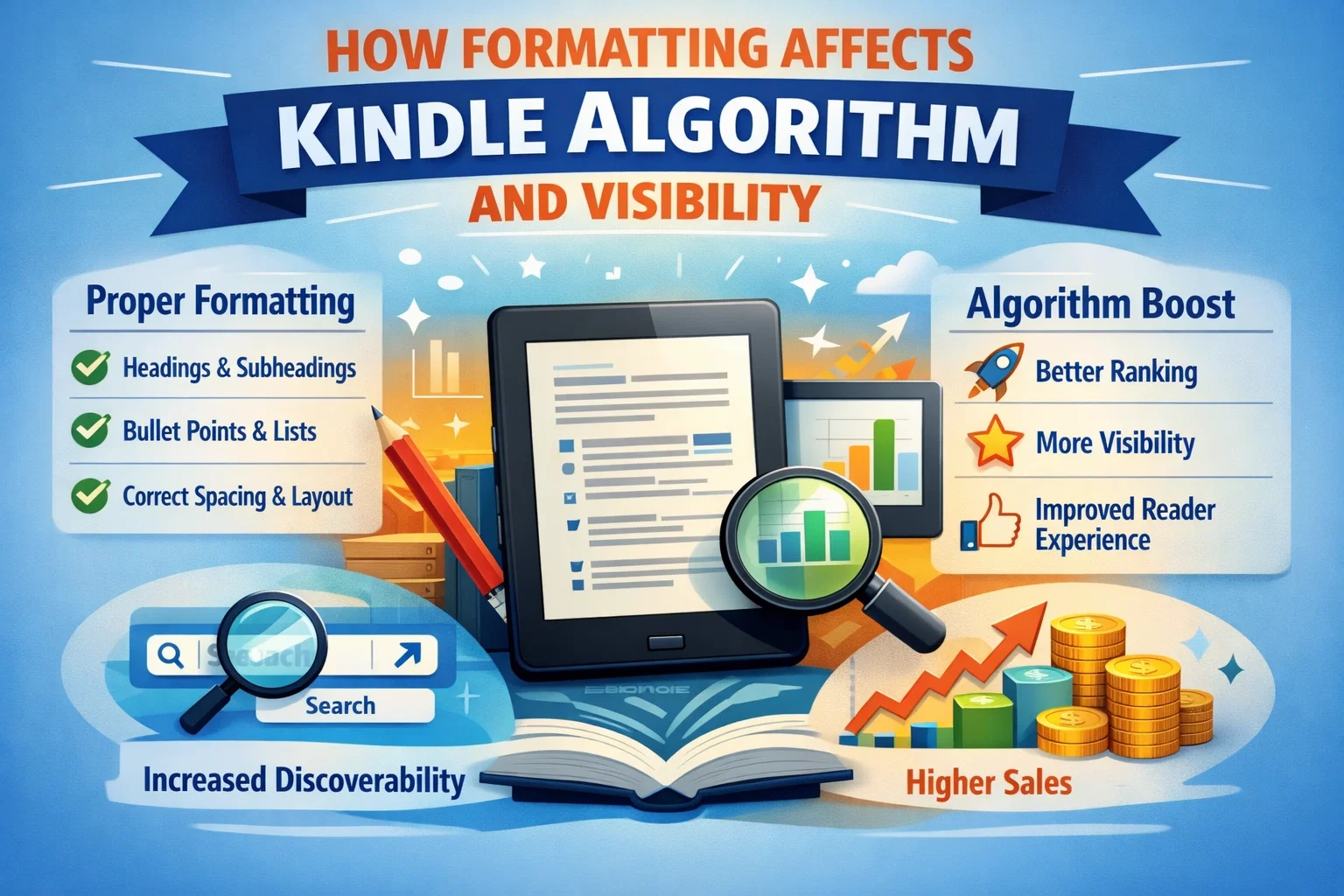
Most authors assume Kindle visibility is driven only by keywords, categories, ads, and reviews. While those factors matter, there’s another element quietly influencing rankings behind the scenes: formatting.
Formatting does far more than improve aesthetics. It directly impacts reader behavior. And on Kindle, reader behavior influences discoverability. If readers stay longer, finish your book, and leave satisfied, the algorithm responds positively. If they abandon early or return the book, visibility weakens.
Understanding how formatting affects the Kindle algorithm helps authors protect their ranking, engagement, and long-term performance.
The Kindle Algorithm Is Built on Reader Signals
Kindle’s system does not publicly disclose every ranking factor. However, one thing is clear: engagement matters.
The algorithm observes patterns such as:
- Sales velocity
- Page reads (for Kindle Unlimited)
- Reader retention
- Completion rates
- Review frequency and sentiment
- Refund or return rates
Formatting influences nearly all of these signals.
Formatting and Reader Retention
Retention is one of the strongest behavioral signals on Kindle. If readers consistently read beyond the first few chapters, your book is performing well in the eyes of the algorithm.
Poor formatting reduces retention because it creates friction. Common issues include:
- Dense blocks of text
- Inconsistent paragraph spacing
- Unclear chapter breaks
- Awkward line wrapping
- Visual clutter
Readers may not consciously identify formatting as the issue, but discomfort shortens reading sessions. When readers leave early, the algorithm notices the drop-off pattern.
Clean formatting supports smooth reading flow, which increases session length and boosts retention signals.
Kindle Unlimited Page Reads and Formatting
For authors enrolled in Kindle Unlimited, pages read are critical. Engagement directly impacts payout and visibility.
If formatting issues cause readers to stop after 10% or 20% of the book, total page reads decline. Lower page reads signal weaker engagement.
Books that maintain consistent, readable formatting tend to accumulate higher read-through rates. Strong read-through improves long-term discoverability and ranking stability.
Preview Conversion and First Impressions
Kindle allows readers to preview a portion of your book before purchase. That preview often includes the opening chapters.
If formatting looks unprofessional in the preview—uneven spacing, awkward margins, inconsistent typography—readers hesitate. Lower conversion from preview to purchase reduces sales velocity.
Sales velocity influences ranking. Even small improvements in conversion can increase visibility over time.
Formatting therefore impacts ranking indirectly through conversion performance.
Formatting and Refund Rates
Refunds are one of the quiet signals Kindle tracks.
Readers frequently request refunds for reasons such as:
- Broken table of contents
- Device compatibility issues
- Text display glitches
- Formatting inconsistencies
- Difficult readability
High refund rates weaken performance signals. While Kindle may not openly penalize formatting mistakes, suppressed engagement often leads to reduced exposure.
Preventing formatting-related returns protects algorithmic momentum.
Cross-Device Compatibility
Kindle books are read across multiple environments:
- Kindle eReaders
- Tablets
- Smartphones
- Desktop apps
Formatting must adapt to different screen sizes. When it doesn’t, readers experience broken layouts or unpredictable spacing.
Cross-device compatibility protects reading comfort. Comfortable reading supports longer sessions. Longer sessions support visibility.
Professional formatting anticipates device variation and minimizes disruption.
Formatting and Review Quality
Formatting issues frequently appear in reviews, even if indirectly.
Comments such as:
- “Hard to read”
- “Layout issues”
- “Felt amateur”
- “Formatting errors”
Even a few negative mentions reduce buyer confidence. Lower click-through rates reduce ranking strength.
Professional presentation improves perceived quality, leading to more positive feedback patterns.
The First 10% Matters Most
Many Kindle ranking patterns are influenced by early engagement. If readers disengage in the opening chapters due to formatting discomfort, the algorithm sees weak performance signals.
Strong formatting helps ensure:
- Clear chapter transitions
- Proper paragraph breaks
- Comfortable line spacing
- Clean typography
The first 10% of your book determines momentum. Formatting supports that early retention window.
Long-Term Visibility and Formatting Stability
Kindle discoverability is cumulative. Books either gain momentum or gradually decline.
Books with consistent formatting quality often experience:
- Higher read-through rates
- Better series performance
- Stronger reader loyalty
- Stable long-term ranking
Formatting strengthens sustainability. It ensures your book remains comfortable to read months and years after launch.
Formatting as a Quality Indicator
While Kindle does not publicly define a quality score, engagement behavior functions as a proxy for quality.
Formatting contributes to perceived quality by:
- Reducing cognitive load
- Improving readability
- Supporting pacing
- Enhancing visual clarity
When presentation supports content, the reading experience improves. Improved experience strengthens behavioral signals. Behavioral signals improve visibility.
Why Keyword Optimization Isn’t Enough
Many authors optimize metadata but overlook formatting. They refine titles, descriptions, and categories—yet visibility stalls.
If reader retention is weak due to formatting friction, algorithmic strength diminishes.
Metadata attracts clicks. Formatting sustains engagement.
Both are necessary for visibility growth.
Conclusion
Formatting influences more than appearance. It shapes reader comfort, engagement, and trust. These behaviors feed directly into Kindle’s ranking patterns.
Clean formatting increases retention, reduces refunds, improves review quality, and strengthens long-term discoverability. Poor formatting quietly undermines performance, even when writing is strong.
At Book Planets, we’ve seen how improving formatting alone can stabilize engagement metrics and enhance Kindle visibility. When presentation aligns with content, the algorithm naturally responds.
Frequently Asked Questions
1. Does formatting directly affect Kindle ranking?
Not directly, but formatting influences reader engagement, which impacts ranking signals.
2. Can poor formatting lower page reads?
Yes. Readers often abandon books early if formatting is uncomfortable.
3. Does formatting matter for fiction novels?
Absolutely. Even simple novels require clean spacing, structure, and consistent typography.
4. Can formatting increase Kindle Unlimited payouts?
Better formatting improves retention, which increases total page reads.
5. Are refunds tracked by Kindle?
Yes. High refund rates can weaken visibility patterns.
6. Does Kindle penalize formatting mistakes?
Not openly, but engagement suppression reduces discoverability.
7. Should I test formatting before publishing?
Yes. Preview your book across devices to ensure consistency.
8. Can formatting impact review sentiment?
Yes. Formatting issues frequently appear in negative feedback.
9. Is professional formatting worth the investment?
For authors focused on visibility and performance, it often strengthens long-term ranking.
10. Does formatting matter more for eBooks than print?
Formatting is critical for both, but digital reading amplifies visibility impact due to behavioral tracking.