
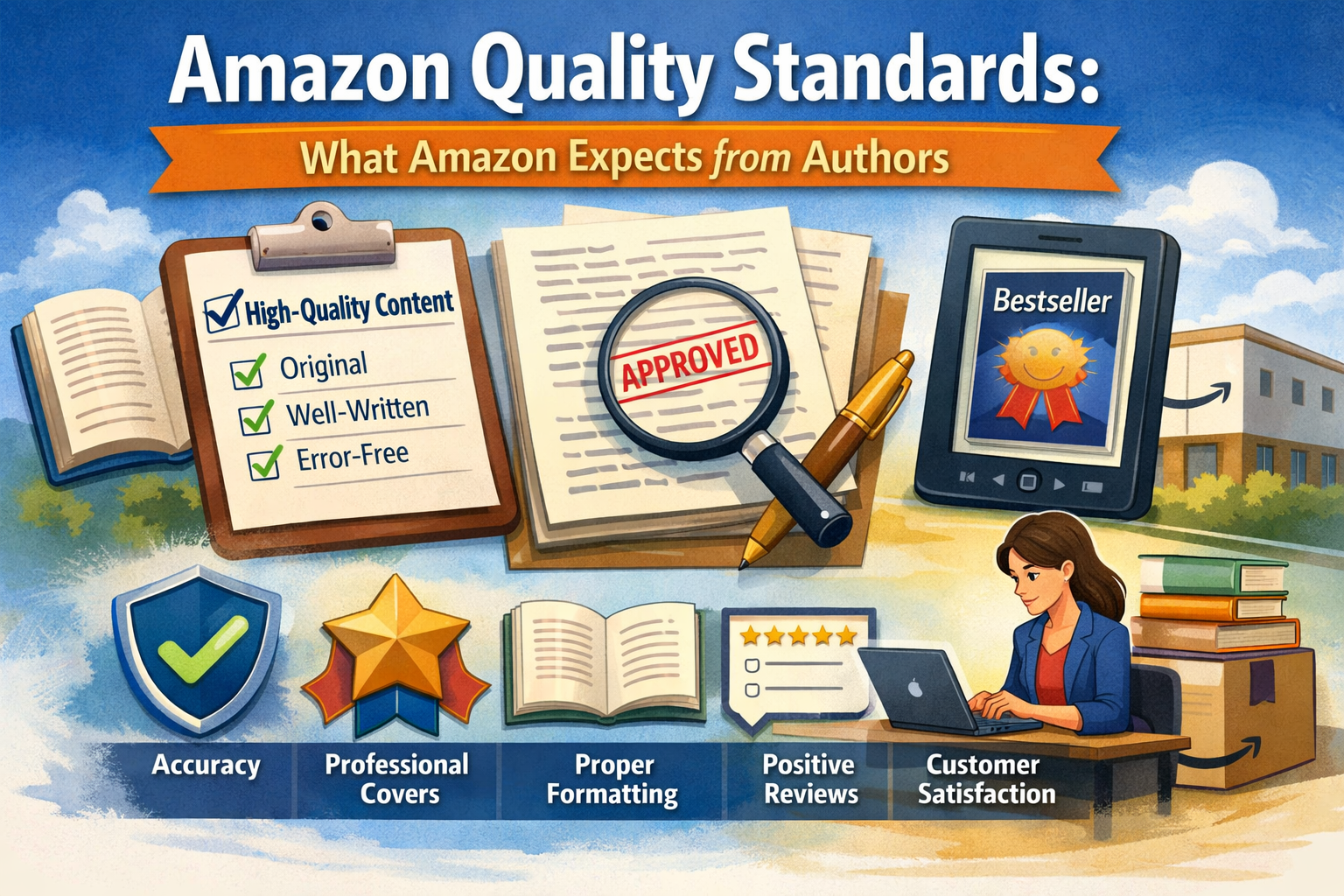
Publishing an eBook on Amazon is easier than ever—but getting visibility, sales, and positive reviews is a different story. With millions of titles competing for attention, Amazon is very selective about which books it promotes, recommends, and ranks well. Many authors assume success depends only on writing talent or marketing spend, but behind the scenes, Amazon evaluates quality signals that directly affect your book’s performance.
Understanding Amazon Quality Standards and What Amazon Expects from Authors can help you avoid common mistakes, meet platform expectations, and dramatically improve your chances of long-term success.
Quality Is More Than Good Writing
Amazon doesn’t manually read every book. Instead, it relies on a combination of technical checks, reader behavior, and feedback signals to determine whether an eBook meets its quality standards.
A high-quality eBook, in Amazon’s eyes, is one that:
- Delivers a smooth reading experience
- Meets technical formatting requirements
- Keeps readers engaged
- Receives positive feedback and low complaint rates
When these elements align, Amazon is more likely to reward the book with better discoverability.
1. Clean, Professional Formatting
One of the first things Amazon evaluates is formatting quality.
Poor formatting is one of the most common reasons eBooks underperform—or get flagged. Amazon expects eBooks to display correctly across different screen sizes and devices, without causing frustration for readers.
Formatting issues that raise red flags include:
- Inconsistent fonts or spacing
- Broken or missing table of contents
- Awkward page breaks
- Images that don’t scale properly
- Text that looks fine on one device but breaks on another
Even if your writing is excellent, formatting problems can lead to negative reviews and higher return rates—both of which signal low quality to Amazon.
2. Strong Reader Engagement Signals
Amazon closely tracks how readers interact with your book after purchase or download. These behavioral signals matter more than many authors realize.
Key engagement indicators include:
- How far readers progress through the book
- Whether they finish it
- How quickly they stop reading
- Whether they return or refund the book
If many readers abandon the book early, Amazon interprets this as a quality issue—even if no one leaves a negative review.
This is why strong openings, clear pacing, and a readable layout are so critical. The first few chapters often determine how Amazon perceives your book.
3. Low Complaint and Refund Rates
Amazon takes customer satisfaction very seriously. If an eBook generates frequent complaints or refunds, it’s flagged internally.
Common reasons readers report or return eBooks include:
- Misleading descriptions
- Poor formatting or readability issues
- Typos and grammar problems
- Content that doesn’t match the genre promise
High refund rates can suppress visibility, reduce promotional opportunities, and in severe cases, lead to account warnings.
4. Consistency Between Cover, Description, and Content
Amazon expects alignment between:
- The book cover
- The description (blurb)
- The actual content
If your cover promises one type of experience and the book delivers another, readers feel misled—and Amazon notices.
For example:
- A professional cover with amateur interior quality
- A fast-paced blurb paired with a slow, unfocused opening
- Genre signals that don’t match the story
Consistency builds reader trust, which leads to better engagement and stronger performance signals.
5. Editorial Quality and Language Standards
While Amazon doesn’t require perfection, it does expect a reasonable level of editorial quality.
Books filled with obvious grammar errors, typos, or awkward sentence structure often struggle—not because Amazon “penalizes” them directly, but because readers disengage quickly and leave poor feedback.
High-quality eBooks typically show evidence of:
- Professional editing or proofreading
- Clear sentence flow
- Logical paragraph structure
- Polished dialogue
Reader trust is fragile. Editorial mistakes break immersion and reduce confidence in the author.
6. A Functional and Clickable Table of Contents
Amazon expects eBooks to be easy to navigate. A proper, clickable table of contents is a basic requirement for quality.
Problems Amazon dislikes include:
- Missing TOC
- TOC that doesn’t link correctly
- Manual TOC pages instead of interactive navigation
A smooth navigation experience improves usability and reader satisfaction—two things Amazon values highly.
7. Appropriate File Size and Technical Stability
Amazon also evaluates the technical health of your eBook file.
Oversized files caused by unoptimized images or bloated formatting can:
- Slow downloads
- Increase delivery costs
- Create a poor user experience
High-quality eBooks are optimized for performance without sacrificing readability or visual clarity.
8. Positive Reviews and Ratings Over Time
While reviews alone don’t define quality, they reinforce it.
Amazon looks for:
- A healthy ratio of positive to negative reviews
- Feedback that mentions readability, clarity, and enjoyment
- Consistent ratings rather than sharp drops
Books with strong early reviews tend to gain momentum, while those with recurring complaints struggle to recover.
Why Many Good Books Still Underperform
Many authors assume that poor sales mean poor writing. In reality, many good books fail because they don’t meet Amazon’s quality expectations in areas like formatting, structure, or reader experience.
This is where professional support makes a measurable difference.
At Book Planets, we often work with authors whose stories are strong—but whose books underperform due to avoidable technical or presentation issues. Fixing these details often leads to better engagement, improved reviews, and stronger long-term visibility.
How Authors Can Align with Amazon’s Expectations
To meet Amazon’s definition of a high-quality eBook, authors should focus on:
- Professional formatting across devices
- Clean, readable layout
- Strong opening chapters
- Clear genre alignment
- Editorial polish
- Consistent presentation from cover to final page
These elements work together to create a book Amazon can confidently surface to readers.
Final Thoughts
Amazon doesn’t reward effort—it rewards reader satisfaction. High-quality eBooks are those that respect the reader’s time, deliver on their promises, and provide a seamless reading experience.
When your book meets these standards, Amazon’s systems naturally respond with better visibility, stronger rankings, and more opportunities for growth.
Frequently Asked Questions
1. Does Amazon manually review every eBook?
No. Amazon primarily uses automated systems and reader feedback to evaluate quality.
2. Can poor formatting hurt my book’s visibility?
Yes. Formatting issues often lead to low engagement and negative reviews, which affect rankings.
3. Are reviews more important than sales for Amazon?
Both matter, but engagement and satisfaction signals often carry more long-term weight.
4. Can I fix quality issues after publishing?
Yes, but early issues can impact momentum. It’s best to publish with quality from the start.
5. Does Amazon penalize low-quality books?
Amazon doesn’t openly penalize, but it reduces visibility when quality signals are weak.